How to Make a Sock Monkey
A complete DIY guide to making a classic sock monkey at home.
A sock monkey is one of the most recognizable handmade plush toys in American craft culture: a soft monkey made from socks, usually with long arms, long legs, a long tail, and a friendly face. The classic style is closely associated with brown work socks and the red heel that became the monkey's distinctive mouth. Sock monkeys became especially beloved during the Great Depression, when families often made toys from simple materials already available at home.
This guide follows the traditional two-sock method: one sock becomes the head, body, and legs; the second sock becomes the arms, tail, ears, and mouth. The result is a soft, personal plush monkey with the handmade character that makes every sock monkey slightly different.
Watch the Full Walkthrough
What You Need
- One pair of clean socks
- Polyester fiberfill or other soft toy stuffing
- Needle
- Thread
- Fabric scissors
- Pins or sewing clips
- Fabric marker, washable pen, or tailor's chalk
- Ruler
- Embroidery floss for the mouth
- Buttons, felt, fleece, or embroidery thread for the eyes
- Optional ribbon, bow, scarf, patch, or other decoration
A sewing machine is helpful, but not required. A sock monkey can be sewn by hand if the stitches are small, firm, and consistent.
Safety Note
If the sock monkey is for a baby or very young child, do not use buttons, beads, loose ribbons, or small detachable decorations. Embroidered eyes or securely sewn felt eyes are safer choices. Always make sure seams are closed tightly and no stuffing can be pulled out.
Choosing the Right Socks
The best socks for a classic sock monkey are medium-weight or thick socks with enough stretch to shape nicely after stuffing. Traditional sock monkeys are often made with brown socks and a contrasting heel, especially a red heel, because the heel becomes the monkey's mouth. Modern sock monkeys can also be made with striped, colorful, patterned, or mismatched socks.
Longer socks create longer arms, legs, and tail. Smaller socks create a smaller monkey. Thick socks make a fuller, sturdier plush. Very thin socks can work, but they may show stuffing through the fabric and may be harder to sew neatly.
Before You Start
- Wash and dry the socks first.
- Turn both socks inside out.
- Smooth them flat.
- Decide which sock will become the body.
- Decide which sock will become the arms, tail, ears, and mouth.
- Use pins before sewing so the fabric does not shift.
- Do not cut too close to the stitch lines. Leave a small seam allowance so the fabric does not open after stuffing.
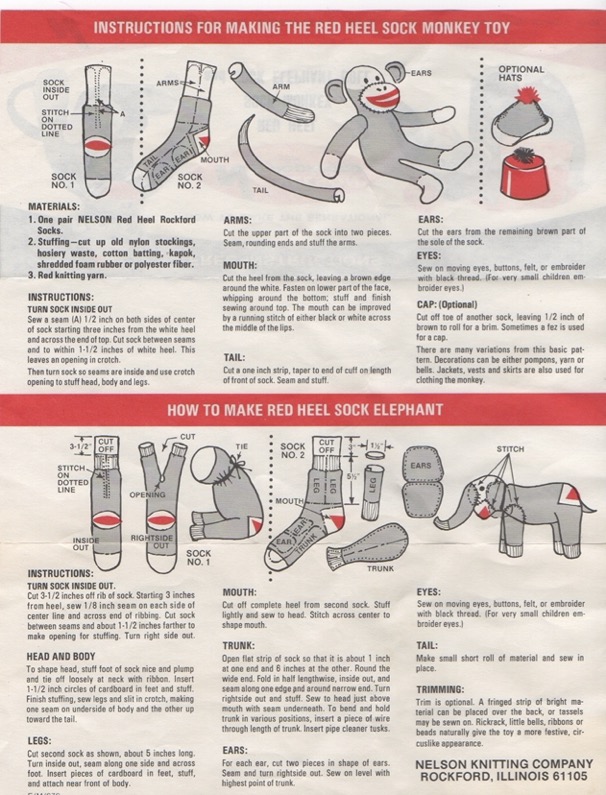
Step 1: Make the Body and Legs
- Take the first sock and turn it inside out.
- Lay it flat with the heel facing up. The heel will become the monkey's bottom.
- From the open cuff end toward the heel, mark a straight center line. This line will separate the two legs.
- Stop the center line before reaching the heel. Leave enough uncut space near the heel so the body stays connected.
- Mark two stitch lines, one on each side of the center line. These will become the inner seams of the legs.
- Sew along the two stitch lines, starting near the cuff and sewing toward the heel. Do not sew directly on the center line, because the center line will be cut open.
- Leave an opening between the legs or near the bottom area. This opening is needed for turning and stuffing.
- After sewing, cut along the center line between the two stitched seams. This separates the legs.
- Turn the sock right-side out through the opening.
At this point, the first sock should look like a soft body with two long legs and a rounded head area.
Step 2: Stuff the Body
- Begin adding fiberfill through the opening.
- Stuff the legs first. Push small amounts of filling into the feet and leg tips so the shape is even.
- Continue stuffing the lower body, belly, chest, and head.
- Use small pieces of stuffing rather than one large clump. This creates a smoother finish.
- The body should feel full but not hard. Overstuffing can stretch the sock too much and make the seams strain.
- Adjust the shape with your hands as you go. The monkey should have a soft belly, rounded head, and flexible legs.
Once the body is evenly stuffed, fold the raw edges of the opening inward and sew the opening closed with small hand stitches.
Step 3: Cut the Arms, Tail, Ears, and Mouth
Take the second sock and turn it inside out. Lay it flat. This sock will provide the remaining pieces:
- Two arms
- One tail
- Two ears
- One mouth
- Optional hat or extra decoration, depending on the sock length
Use the longer straight areas of the sock for the arms and tail. Use the heel section for the mouth. Use smaller remaining sections for the ears. Mark the pieces before cutting: two long narrow arm shapes, one long narrow tail shape, two rounded ear shapes, and one oval or heel-shaped mouth piece.
Sew around the arms, tail, and ears before fully cutting them out when possible. This makes small pieces easier to control. Leave one end open on each arm and tail for turning and stuffing, and a small opening on each ear. After sewing, cut out each piece with a small seam allowance, then turn every piece right-side out.
Step 4: Stuff the Arms and Tail
- Stuff each arm lightly to moderately.
- Stuff the tail lightly if a floppy tail is preferred.
- Stuff the tail more firmly if a structured tail is preferred.
- Do not overstuff the arms. Long sock monkey arms should stay soft and easy to position.
- Fold the raw edges inward at the open end of each piece.
- Keep the pieces ready for attachment.
Step 5: Shape and Attach the Arms
- Place the stuffed body flat on the table.
- Position one arm on each side of the body, slightly below the head and above the belly.
- Pin both arms in place before sewing.
- Check that the arms sit at the same height.
- Hand-sew each arm securely to the body using small stitches around the full opening of the arm.
- Pull gently on each arm after sewing to check that it is firmly attached.
The arms should feel secure but still soft and flexible.
Step 6: Attach the Tail
- Turn the monkey over so the back is facing up.
- Place the tail on the lower back, near the heel area that forms the monkey's bottom.
- Pin the tail in place.
- Check the angle before sewing. A slightly upward or curved tail usually looks more lively.
- Hand-sew around the base of the tail until it is fully attached.
- Reinforce the seam with a second pass if the monkey will be handled often.
Step 7: Make and Attach the Ears
- Take the two rounded ear pieces.
- Add a very small amount of stuffing to each ear. Ears should be soft and slightly padded, not bulky.
- Fold the raw edges inward and sew the opening closed.
- Pin one ear to each side of the head.
- Step back and check the placement. Ears that sit slightly lower create a sweeter, classic expression; ears placed higher look more alert and playful.
- When the ears are even, sew them securely to the head.
Step 8: Add the Mouth
The mouth is the most recognizable part of a classic sock monkey. Use the heel piece from the second sock if the sock has a contrasting heel - this creates the traditional muzzle shape.
- Turn the raw edge of the mouth piece inward.
- Place the mouth piece on the lower front of the face and pin it in place.
- Start sewing around the edge of the mouth, attaching it to the face.
- Before closing the mouth completely, add a small amount of stuffing under the mouth piece. This gives the muzzle a soft raised shape.
- Finish sewing the mouth closed.
The mouth should sit centered on the face and slightly below the midpoint of the head.
Step 9: Add the Smile
Use embroidery floss or strong thread to stitch a smile onto the mouth. A simple curved backstitch works well. Mark the smile lightly before stitching if needed, then start near one side of the mouth, follow the curve, and finish near the other side.
- For a classic look, keep the smile simple and slightly curved.
- For a more playful look, make the smile wider.
- For a calmer look, keep the curve subtle.
Small changes in the mouth shape can completely change the monkey's personality.
Step 10: Add the Eyes
- Place the eyes above the mouth and slightly apart.
- Pin or mark the placement first and check the expression before sewing.
- For a traditional sock monkey, buttons are often used.
- For a child-safe version, use embroidered eyes or soft felt eyes.
- If using buttons, sew them tightly with several passes of thread.
- If embroidering eyes, use small satin stitches, French knots, or simple stitched circles.
- If using felt, sew around the full edge of each felt piece so it cannot lift easily.
The eyes should be level unless a deliberately quirky expression is desired.
Step 11: Add Optional Details
A sock monkey can stay simple, or it can be personalized. Optional details include:
- Ribbon scarf
- Fabric bow
- Tiny hat
- Heart patch
- Name tag
- Embroidered initials
- Felt cheeks
- Small vest
- Holiday accessory
Keep decorations lightweight and secure. For babies and young children, avoid anything that can be pulled off, wrapped around fingers, or placed in the mouth.
Step 12: Check the Finished Monkey
Before calling the sock monkey finished, inspect every seam - the leg seams, the opening between the legs, the arms, the tail, the ears, the mouth, and the eyes - and check for loose threads or small pieces that may detach.
Gently squeeze the monkey and reshape the stuffing. Roll the arms and tail between your hands to smooth them out. Adjust the head and belly until the monkey has the right expression and posture.
Care Instructions
Most handmade sock monkeys should be cleaned gently.
- Spot clean with mild soap and cool water.
- Do not scrub aggressively.
- Do not twist the monkey to remove water.
- Press with a towel to remove excess moisture.
- Air dry completely.
- Reshape the arms, legs, tail, and face while drying.
If the sock monkey is made from washable socks and all parts are securely sewn, hand washing may be possible. Machine washing can distort the stuffing, loosen seams, or damage decorations, so gentle hand cleaning is usually the safer choice.
Common Mistakes to Avoid
- Cutting before sewing the small pieces
- Cutting too close to the stitch line
- Overstuffing the body
- Understuffing the feet and hands
- Placing the mouth too high
- Sewing the arms at uneven heights
- Using buttons for a baby toy
- Leaving weak seams near the legs
- Using socks that are too thin
- Pulling thread too tightly and puckering the fabric
A sock monkey does not need to look perfect. Small differences are part of the charm. The goal is a soft, secure, expressive plush with character.
How Long Does It Take?
A beginner can usually make a sock monkey in one afternoon. The process is simple, but careful cutting, stuffing, and hand-sewing make the finished monkey look much better. The first monkey may take longer. The second one is usually faster and cleaner.
Best Uses for a Handmade Sock Monkey
A handmade sock monkey can be a birthday gift, holiday gift, baby shower decoration, nursery accent, travel companion, keepsake, craft project, or collectible. It can also be made from meaningful socks to create a more personal gift.
For a polished gift, pair the handmade sock monkey with a ready-made classic sock monkey from the shop. One carries handmade personality; the other brings the soft, finished feel of a gift-ready plush. Together, they make a thoughtful set for kids, collectors, and anyone who loves nostalgic toys.
DIY Sock Monkey Checklist
- One pair of socks
- Stuffing
- Needle and thread
- Scissors
- Pins
- Fabric marker
- Eye material
- Embroidery floss
- Body sewn
- Legs cut and turned
- Body stuffed
- Arms sewn and attached
- Tail sewn and attached
- Ears sewn and attached
- Mouth sewn and lightly stuffed
- Smile stitched
- Eyes attached
- All seams checked
- Final shape adjusted
A Handmade Classic
The beauty of a sock monkey is that it begins with something ordinary and becomes something personal. Two socks, some stuffing, and careful stitches turn into a plush toy with expression, history, and charm. That is why sock monkeys remain loved across generations: they are simple, soft, nostalgic, and never exactly the same twice.
Prefer a Ready-Made One?
Skip the sewing and gift a classic right away. Browse soft, finished sock monkeys in every size on Amazon.